


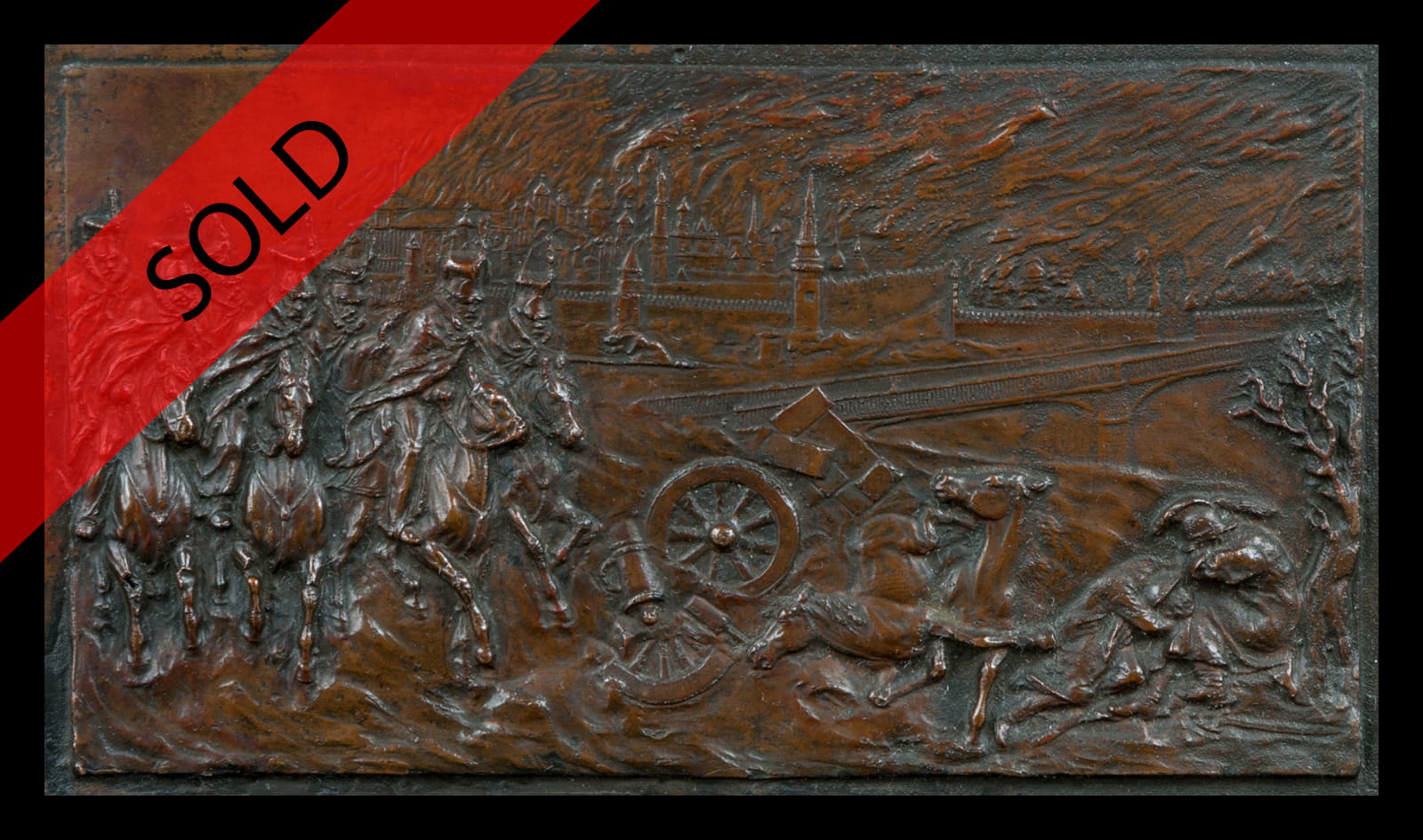
Antoni Kurzawa, 'A Retreat from Moscow in 1812' Plaque , Edward Krasnosielski Works, 1914-18, Warsaw
 Description
Plaque made using electroplating technique, 8x14 cm.
Unique project by Wojciech Kossak and Antoni Kurzawa from 1887/1888 to the so-called Cases of Józef Poniatowski, prepared for the Universal Exhibition in Paris.
Antoni Kurzawa (Turza 1842 - 1898 Cracow) - an outstanding Polish sculptor, coming from the social lowlands. All the surrounding nature, the environment, have influenced the development of the innate sense of beauty more than Academy of Fine Arts, which he got thanks to the help of wealthy people. In 1863, he presented the sculpture 'Praying Woman'. He made tombstones at the Łyczakowski cementery. He created a number of works: Saint Magdalena meeting Christ after the Ressurection, Portrait of Walery Wielogłowski, Samson rending the lion's mouth, Kiss of Judas. In the capital city, he gained the popularity of Polish dance figures: Mazur, Oberek or Polonaise.
He also made historical reliefs: Somosierra, Moscow Fire, Lance's Trial, Passage through Willa or Retreat from Moscow in 1812. In Warsaw, he collaborated with the Fraget company, for which he designed the Sobieski's Plock, with an episode of the Battle of Vienna.
His most remarkable work is the scuplture Mickiewicz, Arousing the genius of poetry , he staged it in a sculptural contest of the Society for the Encouragement of Fine Arts in 1890. He shattered it when he was not awarded the first prize, soon he fell ill with a mental illness that stopped his creative activity. Under the influence of his friend Józef Chełmoński, he created yet another bigger canon - The Sower. In 1897 he was placed in a facility for the elderly and the terminally ill. He died in 1898 in Cracow.