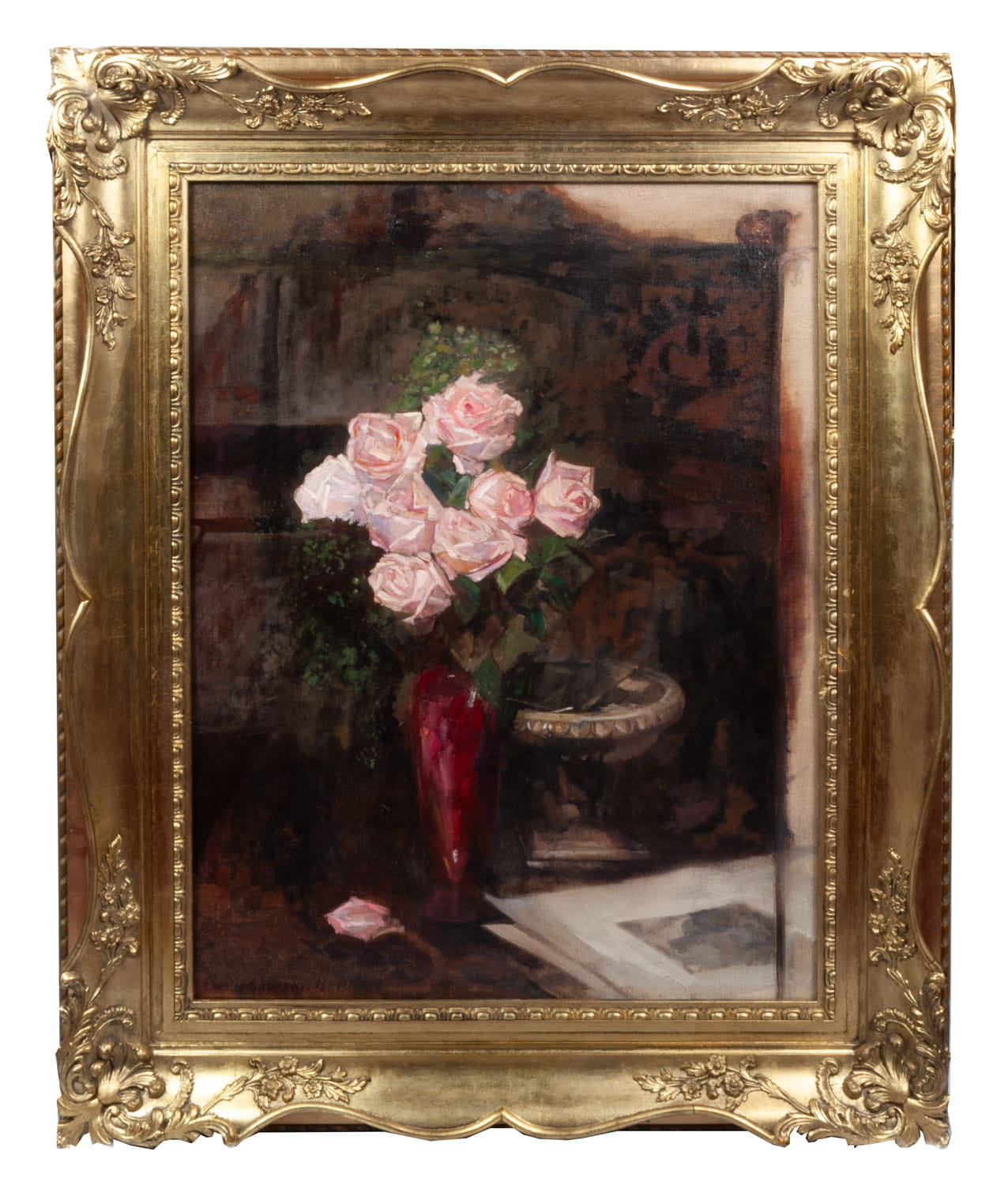
Bolesław Czedekowski "Still life with roses", 1915
 Description
Oil on canvas, signed and dated lower left: "Czedekowski B. 1915"
Framed 98x78 cm (75x60 cm)
Bolesław Jan Czedekowski (1885 – 1969) was a celebrated Polish artist, who spent the vast majority of his life living abroad. Maintaining studios in Paris and Vienna, Czedekowski would spend a long career portraying high society on both sides of the Atlantic. He studied at the Academy of Fine Arts in Vienna, under Kazimierz Pochwalski and Heinrich von Angeli. During his time in the Austrian capital, he was bestowed with various prizes for academic merit, winning the prestigious 'Füger Medal' in his second year. He would graduate in 1907, but would remain a further four years at the academy. In 1913, he married Eugenie Nell, who gave birth to their first daughter, Helene, in 1914. A year later he would join the army as a soldier, only to become a military artist shortly after. He painted the Emperor Charles I in 1917 and exhibited at the War Exhibition of Austrian Painters and Sculptors in 1920. The period after the First World War saw Czedekowski gain prominence as a portrait painter. In 1920, he and his family would move to the US, where a short but successful spell, announced himself to fashionable society on that side of the Atlantic. Returning to Europe a few years later, he would continue portraying high society from his studios in Paris and Vienna. In 1923, he visited an independent Poland for the first time. Towards the end of the 1920s Czedekowski's visits to Poland became increasingly frequent, by 1930 he was commissioned to paint the President Ignacy Moscicki. The portrait was well received and would encourage further commissions from the Polish elite: aristocrats, politicians, industrialists and clergymen all proved willing patrons for Czedekowski's paintbrush. Though constantly on the move, Czedekowski resided in Paris from 1923 to 1938; his rising reputation in that city, resulted in him being made a knight of the Légion d'honneur in 1934. In Warsaw at the outbreak of the Second World War, Czedekowski fled to Vienna, where he observed the occupation of Poland from afar. He was stirred profoundly by the horrors of War and produced a series of paintings entitled "The War in Poland." His portrait of General George S. Patton Jr., painted at the end of the War, now hangs in the Smithsonian National Portrait Gallery in Washington D.C. Czedekowski emigrated to the US in 1946, experiencing some of his most successful years. He would exhibit frequently across numerous states, becoming an American Citizen in 1952. After the sudden death of his wife in 1953, he returned to Europe, married Hertha Aujezedecky and lived out the remainder of his days in Vienna. Continuing to visit his homeland, now behind the Iron Curtain, he exhibited in Cracow in 1964 and received the 'Order of Polonia Restituta' at the Palace of Culture in Warsaw. Though overwhelmingly a painter of portraits, he painted a selection of landscapes whilst holidaying in Salzburg in his final years. He exhibited for a final time with the International Artist's Club at the Palais Palffy in Vienna at the beginning of 1965.
 Related products
Zofia Albinowska-Minkiewiczowa "Still life with roses"
Jan Książek “Still life with flowers”, 1947