


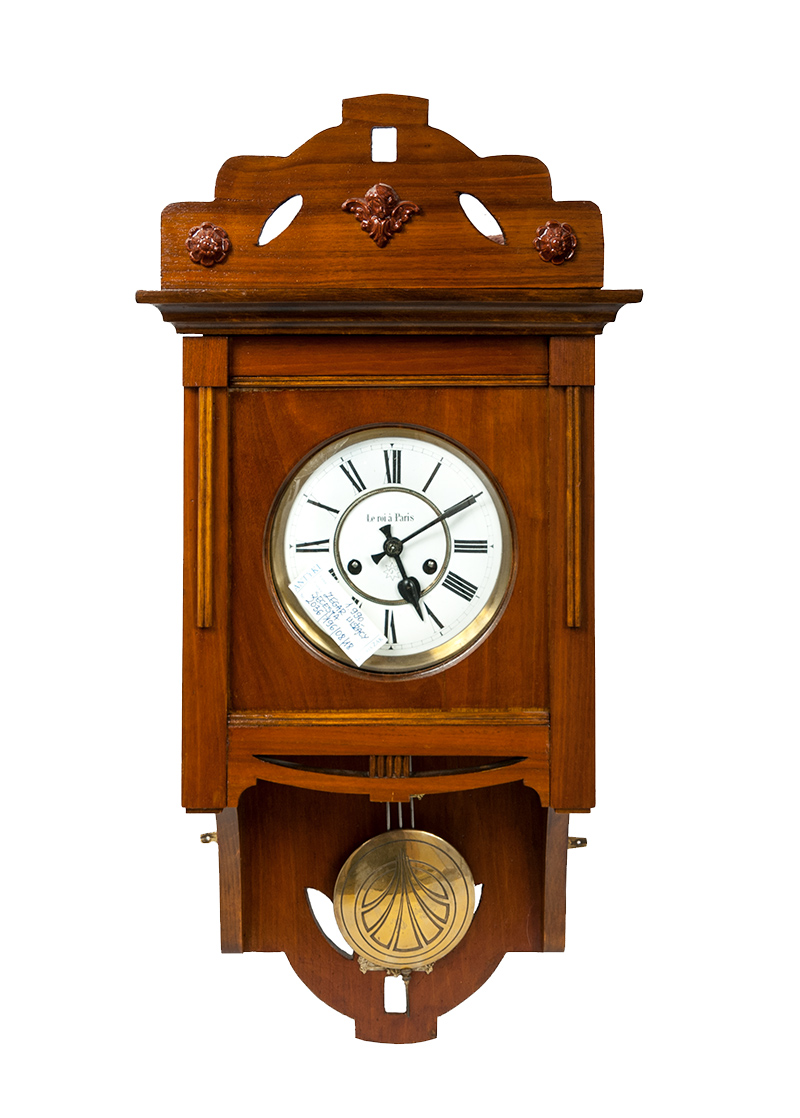
Art Nouveau Clock, Gustav Becker, circa 1900
 Description
Wall clock in the silesian style, signed. Pine structure, walnut veneer. Lenght 75 cm, width 30 cm.
Gustaw Eduard Becker (Oels 1819 - 1885 Berchtesgaden) - German clockmaker and founder of the brand Gustav Becker. He learned clockmaking in Silesia and enriched his skills by learning from many masters around Germany which, during that era, was the most important country in the clock industry. In 1847 in Friburg he opened a small clock shop with few employees to whom he taught clockmaking. First, he created clocks in the Viennese model, and thanks to his success, in 1850 he moved his business to a better business centre. His breakthrough came in 1852 at the Silesian Clock Fair. Crowds were drawn to his works because of quality, and he was awarded the gold medal for the best clock in the fair. In 1854 he received large orders from the British Royal Mail and the Silesian Telegraphy Centre. After the orders, he received a fortune from the Duke of Martibore, and with this money he could pay enough to make clock cases for train stations. In the 1860s, he began to create the Classical Gustav Becker clocks. starting from fairly simple clocks, the clocks became complex and very ornamental, and sales rose to a peak in 1875, with over 300 000 clock orders. He won clock fairs in London, Paris, Sydney, Melbourne, Berlin and Amsterdam. During the 1880s, the Black Forest clockmakers began competing with Becker, with good quality, less-expensive models. With the decline of sales, Becker stopped selling complex clocks, and returned to making more simple designs.