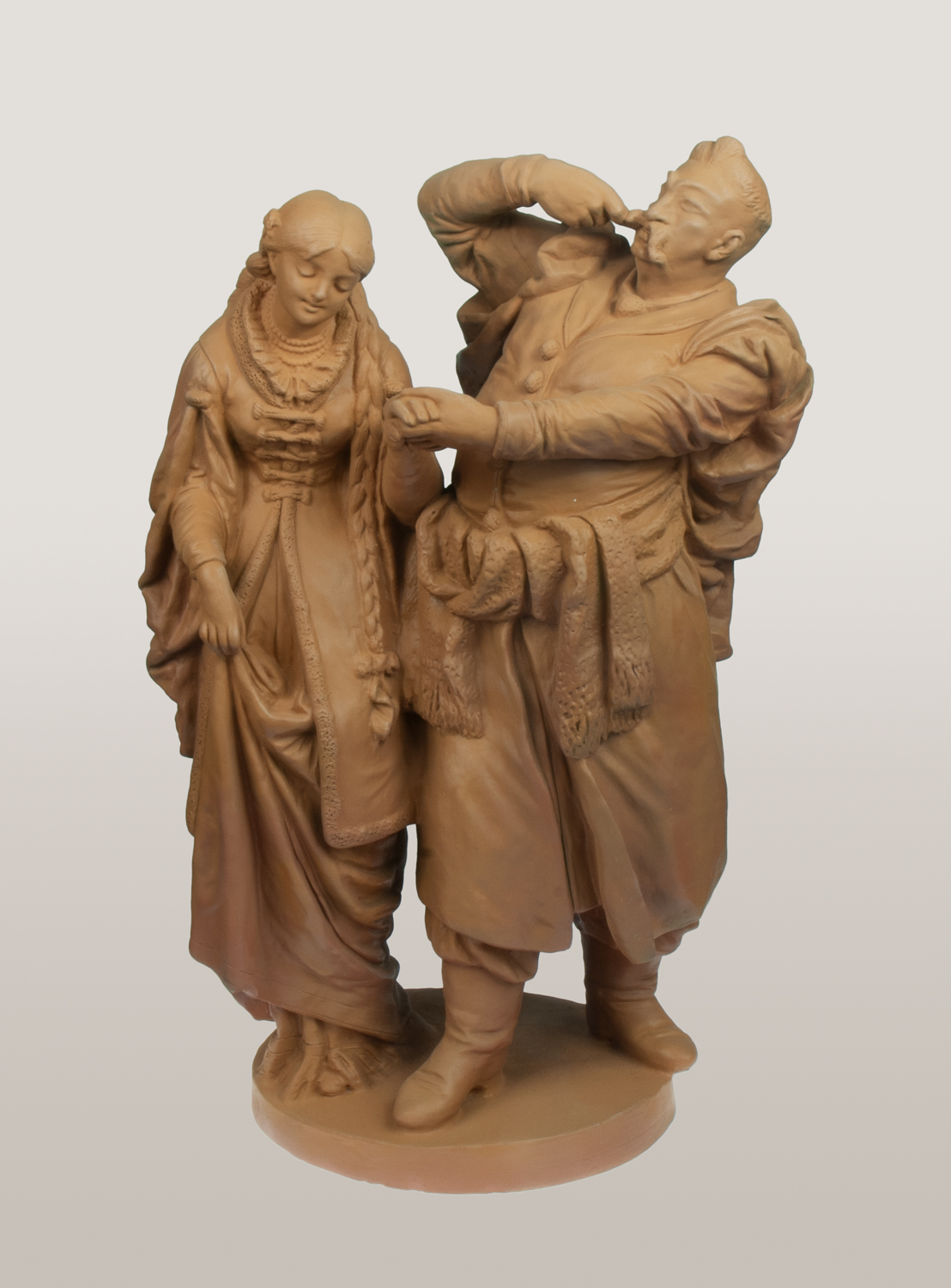
Antoni Kurzawa “Polonaise”
 Description
Sculpture made of terracotta.
Kurzawa's cycle of "Polish Dances" was created at the turn of the 1870s and 1880s.
Height: 51 cm
Antoni Kurzawa (Turza 1842 - 1898 Cracow) - an outstanding Polish sculptor, coming from the social lowlands. All the surrounding nature, the environment, have influenced the development of the innate sense of beauty more than the Academy of Fine Arts, which he got thanks to the help of wealthy people. In 1863, he presented the sculpture 'Praying Woman'. He made tombstones at the Łyczakowski cemetery. He created a number of works: Saint Magdalena meeting Christ after the Resurrection, Portrait of Walery Wielogłowski, Samson rending the lion's mouth, Kiss of Judas. In the capital city, he gained the popularity of Polish dance figures: Mazur, Oberek or Polonaise. He also made historical reliefs: Somosierra, Moscow Fire, Lance's Trial, Passage through Willa or Retreat from Moscow in 1812. In Warsaw, he collaborated with the Fraget company, for which he designed the Sobieski's Plock, with an episode of the Battle of Vienna. His most remarkable work is the sculpture Mickiewicz, Arousing the genius of poetry , he staged it in a sculptural contest of the Society for the Encouragement of Fine Arts in 1890. He shattered it when he was not awarded the first prize, soon he fell ill with a mental illness that stopped his creative activity. Under the influence of his friend Józef Chełmoński, he created yet another bigger canon - The Sower. In 1897 he was placed in a facility for the elderly and the terminally ill. He died in 1898 in Cracow. Bracia Łopieńscy – A family company operating in Warsaw since 1862, specializing in the production of products made of bronze, silver and precious metals. In the interwar period, Bracia Łopieńscy products were considered among the best on the Polish market, which was confirmed by awards received at exhibitions in Poland and abroad, including: in 1894 in Lviv, in 1929 in Poznań and in 1925 at the World Exhibition in Paris. An important part of the company's activity was the casting of sculptures, medals and monuments. The designer of many of the company's products was the painter Jan Strzałecki, and his works were also cast there by, among others, Xawery Dunikowski, Cyprian Godebski, Henryk Glicenstein, Stanisław Jackowski, Antoni Kurzawa, Konstanty Laszczka, Antoni Madeyski, Czesław Makowski, Ludwika Nitschowa, Andrzej Pruszyński, Jan Raszka, Pius Weloński and Edward Wittig. After World War II, the Łopieński brothers' factory recreated, among others, destroyed monuments in Warsaw.
 Related products
Konstanty Laszczka “View of Regle” 1905
Teodor Axentowicz “Reflecting”, 1892