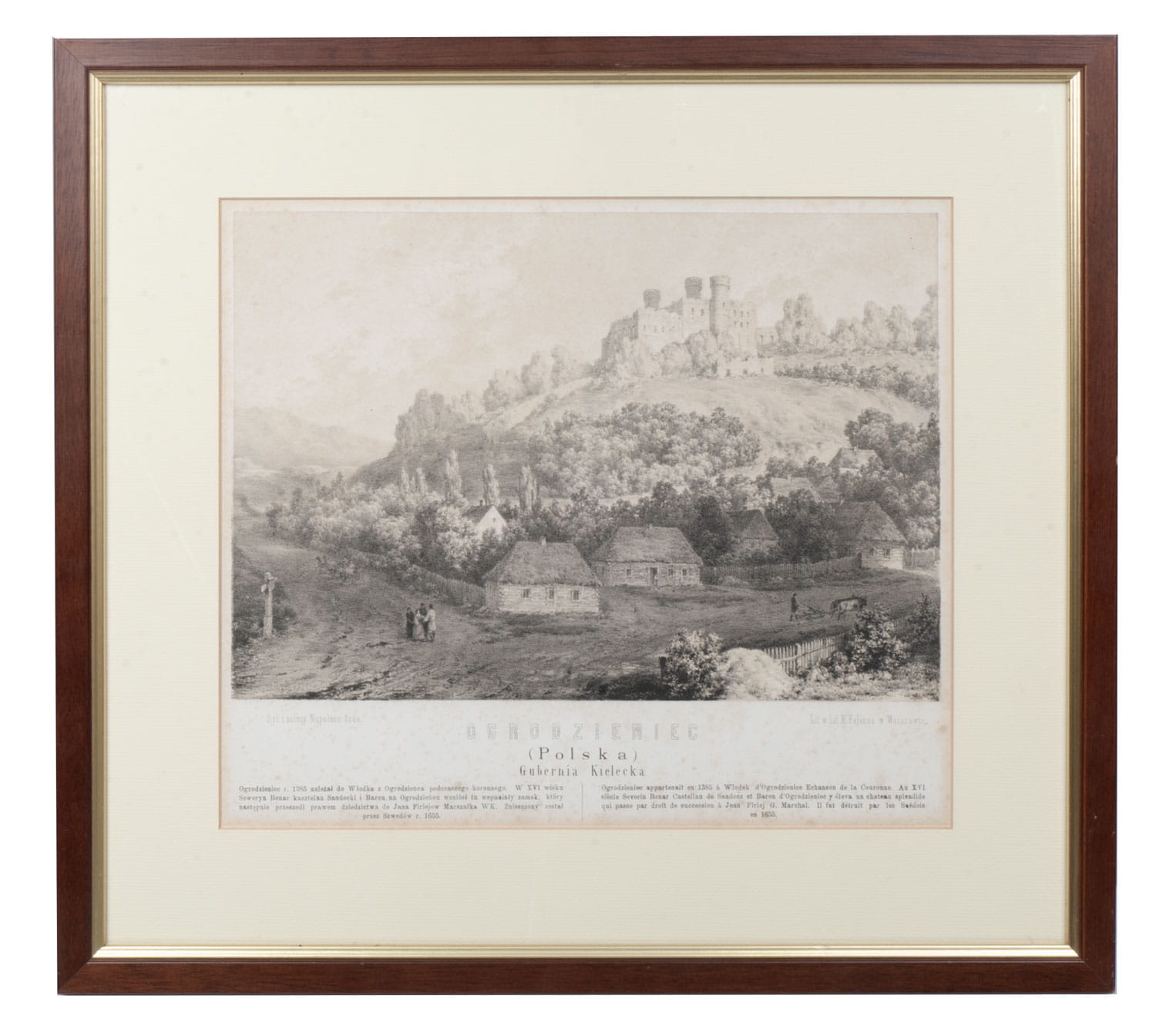
Napoleon Orda “Ogrodzieniec” circa 1880
 Description
Lithograph on paper, signed. A print from the lithography studio of Maksymilian Fajans.
Framed: 38,5x42,5 cm (25x29 cm)
Napoleon Mateusz Tadeusz Orda ( 1807 – 1883) was a Polish-Lithuanian musician, pianist, composer, and artist, best known for numerous sketches of historical sites of the former Polish–Lithuanian Commonwealth. In 1872, Orda started to travel through the lands of the partitioned Polish–Lithuanian Commonwealth and document its historical landmarks and architecture. During his summer trips throughout the country he made more than 1,000 sketches depicting various towns, cities and historical landscapes. He also depicted landscapes, urban and rural architecture, churches and palaces of the partitioned Commonwealth, which included the regions of present-day Belarus, Lithuania, Poland, Ukraine, as well as several regions of France, Germany, Portugal and Switzerland. His works are pencil sketches tinted with watercolour, gouache and sepia. Between 1872 and 1874 he visited most of the notable castles, manors and towns in Volhynia, Podolia and Ukraine. Until 1877 he documented the historical heritage of Lithuania, Samogitia, Livonia and Belarus. In 1878 and 1879 he made a trip to Galicia, Greater Poland and Royal Prussia and finally in 1880 he portrayed the Congress Poland. Approximately 260 of his sketches were turned into lithographies by Alojzy Misierowicz and published in Warsaw by Maksymilian Fajans in a series of eight albums under the collective title Album of Polish Historical Landscapes (Polish: Album widoków historycznych Polski) between 1873 and 1883.
 Related products
Józef Tom "Warsaw"
Józef Tom "Street", 1948